

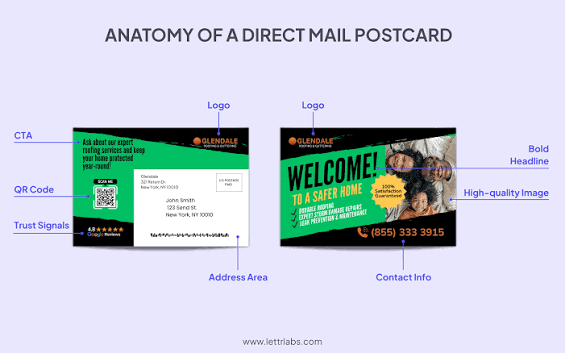
For businesses operating in Detroit and the surrounding metro area, direct mail remains one of the more reliable ways to reach customers at a physical address. Unlike digital advertising, which competes for attention on screens already crowded with notifications and competing messages, a printed postcard arrives in a specific mailbox, on a specific day, handled by a real person. That tactile quality is not incidental — it is part of why postcard campaigns continue to produce measurable responses for local service providers, retailers, medical offices, and event organizers.
What makes postcard printing in Detroit distinct from a general discussion of direct mail is the local operational context. Businesses here are often managing tight service territories, seasonal demand cycles, and customer bases that span both urban neighborhoods and suburban corridors. Getting a postcard campaign right means understanding not just how to design a card, but how print production timelines, list targeting, postal requirements, and delivery logistics all connect into a single workflow. When any of these elements are out of alignment, the result is wasted print budget, delayed delivery, or cards that reach the wrong households entirely.
This guide covers the full process — from preparing your artwork to understanding how your cards move through the postal system — so you can plan and execute a postcard campaign with confidence.
What Postcard Printing in Detroit Actually Involves
Postcard printing is not simply a matter of sending an image file to a printer and waiting for finished cards to arrive. The process involves a series of decisions that affect print quality, cost efficiency, delivery speed, and campaign effectiveness. For anyone working through this process for the first time, or looking to improve results from previous campaigns, a structured Postcard Printing Detroit guide helps clarify how each step connects to the next.
Detroit-area businesses typically approach postcard printing through one of two channels: working with a local commercial printer that handles production only, or working with a direct mail service provider that manages printing, address list processing, and postal submission together. Each approach has real implications for how much coordination falls on the business versus the vendor.
Production-Only vs. Full-Service Print Mail
When a business prints postcards through a production-only shop, the responsibility for list management, addressing, sorting, and postal submission stays in-house. This works well for organizations that already have a clean, formatted mailing list and staff who understand USPS requirements. It tends to break down when address data has not been validated, when indicia or postal endorsements are missing from the design, or when the business underestimates the time required to prepare a mailing for submission.
Full-service direct mail providers handle the entire chain — design review, print production, list processing, CASS certification of addresses, postal sorting, and drop shipment to the appropriate USPS facility. For most small and mid-sized Detroit businesses, the full-service model reduces the risk of costly errors and simplifies what is otherwise a multi-step coordination process. The tradeoff is a slightly higher per-piece cost, which is often offset by reduced internal labor and fewer reprints due to errors.
Designing a Postcard That Functions in the Real World
Effective postcard design is constrained by postal requirements, print production specifications, and the physical reality of how mail is handled and read. A design that looks compelling on a screen but fails to account for bleed margins, safe zones, or address block placement will cause problems at the production stage — or worse, at the delivery stage, when the card arrives damaged or with text cut off.
Understanding Bleed, Safe Zones, and Address Placement
Commercial printers require artwork to extend slightly beyond the final trim size to avoid white edges after cutting. This extended area is called the bleed. Critical content — headlines, contact information, logo elements — must sit inside the safe zone, which is inset from the trim edge to ensure nothing important gets cut during production. Designers who are unfamiliar with these constraints often submit files that require revision, which delays production and, in time-sensitive campaigns, can push the mailing past a planned delivery window.
The address side of the postcard must also conform to USPS layout standards. The address block, postage area, and any barcodes generated during postal processing need dedicated, unobstructed space. Background images that extend into the address area can interfere with barcode legibility, which creates issues during automated sorting and can result in delayed or undeliverable pieces.
Color, Coating, and Readability Under Real Conditions
Postcards are read quickly and often under poor lighting — at a kitchen counter, near a mailbox, or while sorting through a stack of mail. Design choices that work in a controlled viewing environment may not hold up in these conditions. High-contrast layouts with clear typographic hierarchy tend to perform better than designs that prioritize visual complexity over readability.
Coating selection also affects how the card reads in hand. Gloss coating makes colors appear richer and protects the surface, but it can make handwritten notes difficult to add and causes glare under certain lighting. Matte and soft-touch coatings offer a more subdued finish and read well in a wider range of lighting conditions. For postcards with a large text area on the back, an uncoated or matte surface often serves the reader better.
Mailing Lists and Targeting in the Detroit Market
A well-printed postcard delivered to the wrong address produces no result. List quality is one of the most significant variables in postcard campaign performance, and it is also one of the most frequently underestimated. Detroit’s residential geography is layered — neighborhoods vary significantly in density, household type, income level, and tenure — which means that a generic, broad-area list will almost always include a meaningful percentage of addresses that are irrelevant to the campaign objective.
Purchased Lists vs. House Lists
Businesses new to direct mail often purchase demographic or geographic lists from data providers. These lists can be filtered by postal route, zip code, household income range, presence of children, homeownership status, and similar criteria. The quality of purchased lists varies by provider, and even well-filtered lists carry some percentage of outdated or undeliverable addresses. Running a purchased list through CASS-certified address validation software before printing reduces waste and improves deliverability.
House lists — compiled from a business’s own customer database, inquiry records, or point-of-sale system — typically outperform purchased lists in response rate. Existing customers already have a relationship with the business, and a postcard targeting this group operates differently than one reaching cold prospects. Combining both approaches — a re-engagement campaign to the house list alongside a new-acquisition campaign to a purchased list — allows a business to run parallel objectives from a single print run, provided the messaging is adjusted accordingly.
USPS Every Door Direct Mail as an Alternative
For businesses targeting a defined geographic area rather than a specific demographic profile, the USPS Every Door Direct Mail program offers a cost-effective option. Under this program, described in detail in the official USPS business resources, businesses can mail to every active delivery point on a selected postal carrier route without needing individual names or addresses. This eliminates list purchase costs and simplifies addressing requirements, though it removes the ability to filter by household characteristics within the chosen route.
EDDM works well for restaurants, home service companies, real estate agents, and retail businesses with a clear service radius. It is less appropriate for campaigns that require demographic filtering or that are reaching an existing customer base by name.
Print Production Timelines and What Affects Them
One of the more common planning errors in postcard campaigns is underestimating how long the production and delivery cycle takes. Businesses that assume a campaign can go from concept to mailbox in a few days are often working from digital advertising timelines, which do not apply to print.
From File Submission to Print Completion
Once print-ready artwork is submitted and approved, production time for postcard runs varies depending on the press type, order volume, and current shop capacity. Digital press runs tend to produce faster turnarounds than offset printing, which requires setup time for plates and ink calibration. Offset printing, however, offers more consistent color accuracy across large volumes, which matters for campaigns where brand color fidelity is important.
Busy print seasons — typically late fall before the holiday period and early spring — can extend standard turnaround times. Planning campaigns with buffer time before the intended in-home delivery date protects against production delays and allows for artwork revisions if file issues are identified during prepress review.
Postal Transit Time in the Detroit Area
After a mailing is submitted to USPS, delivery does not happen on a fixed schedule. Standard letter mail and flat mail classes move through regional distribution centers before reaching local carriers. Transit time within the Detroit metro area is typically measured in a range of days, not a specific date, and can be affected by mail volume at the processing facility, weather disruptions, and the destination’s proximity to a local post office.
Campaigns built around a specific date — a sale event, a grand opening, or a service window — should account for this variability by submitting the mailing well in advance. Working backward from the intended in-home date to establish a print completion deadline, and then to an artwork submission deadline, is a basic but essential planning discipline.
Measuring Results and Informing Future Campaigns
Postcard campaigns are measurable, but the mechanisms for tracking response differ from digital channels. Without deliberate tracking structures built into the campaign, it becomes difficult to determine which mailings generated inquiries, conversions, or visits.
Practical Response Tracking Methods
Common approaches to tracking postcard response include assigning a specific phone number or extension to the mailing, creating a landing page URL unique to the campaign, or including a promotional code redeemable only through the postcard. Each method creates a clear attribution path without requiring sophisticated technology.
Businesses running multiple campaigns simultaneously — to different list segments, geographic zones, or with different offers — benefit from using distinct tracking identifiers for each version. This allows comparison across segments and provides data for refining future targeting and messaging decisions.
• Unique phone numbers or call tracking extensions tied to a specific mailing make it straightforward to count inbound calls generated by that campaign without affecting the main business line.
• Campaign-specific landing pages allow web analytics to capture visit volume, time-on-page, and conversion actions tied directly to the postcard as a traffic source.
• Promotional codes or offer identifiers create a record at the point of redemption, whether that happens in-store, online, or over the phone, giving the business a direct count of postcard-influenced transactions.
• Tracking response rates across seasonal campaigns builds a historical baseline that improves future planning decisions around timing, list selection, and offer structure.
Bringing the Process Together
Postcard printing in Detroit is a practical, well-established channel that continues to produce results for businesses that approach it with appropriate planning. The process is not complicated, but it is sequential — each phase builds on the one before it, and errors introduced early tend to compound rather than resolve themselves downstream.
The most consistent campaigns share a few common characteristics: artwork that meets production specifications without requiring revision, address lists that have been validated before print, realistic timelines that account for production and postal transit, and a tracking mechanism that connects response back to the specific mailing. None of these require significant resources. They require attention to process and a clear understanding of how print mail actually works from start to finish.
For Detroit businesses evaluating whether postcard printing fits their current marketing mix, the decision ultimately comes down to whether a physical, addressed piece of communication reaches the right people at the right time with a clear and credible message. When those conditions are in place, postcard campaigns remain one of the more dependable and cost-transparent options available in local marketing.
