

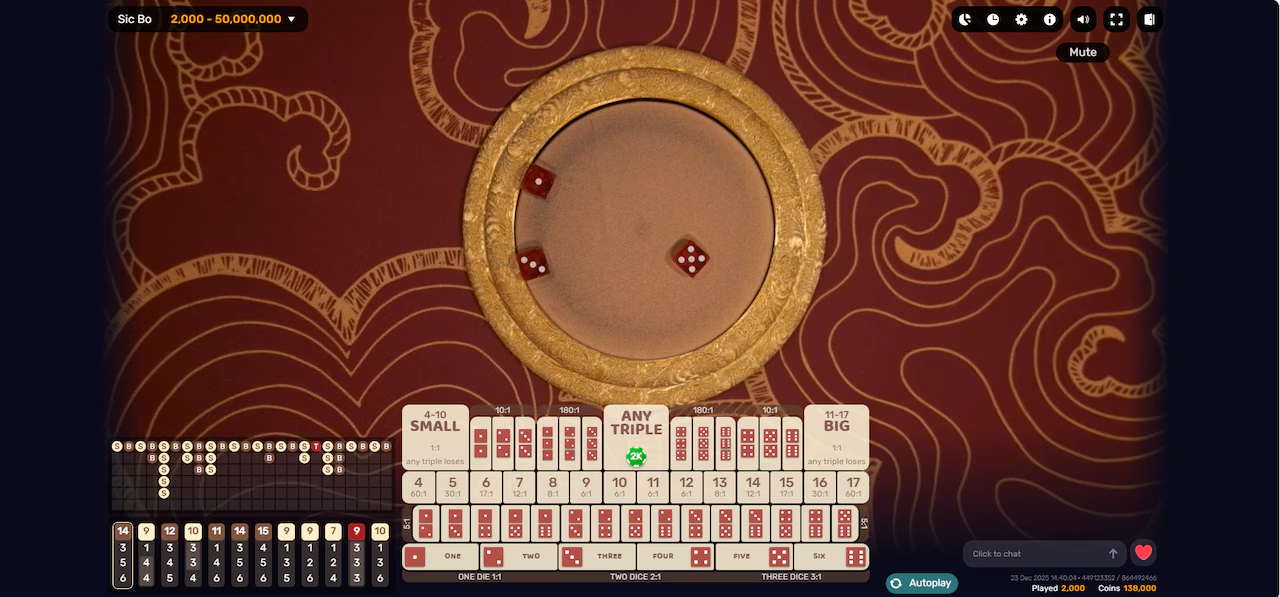
Mega Sic Bo takes the familiar three-dice Sic Bo framework and grafts two key elements onto it: random win multipliers and elevated table limits. The combination means each resolved round can move a large bankroll quickly, because high-stake bets and occasional boosts up to 1,000x interact with the same probability structure that governs all Sic Bo games.
What Makes Mega Sic Bo “Mega” for Dice Players
Mega Sic Bo is built on Pragmatic Play’s live Sic Bo engine but expands the betting grid and overlays random multipliers on selected outcomes each round. There are 52 positions on the board, covering totals, combinations, singles, doubles, and triples, with standard payouts ranging from 1:1 up to about 150:1 before multipliers apply. Random boosts can then elevate some of those positions to returns as high as 1,000:1 when a specific triple hits at the top of its multiplier range, turning a single high-limit wager into a potentially session-defining event for large-stake users.
High Table Limits and Their Practical Consequences
High-limit tables in Mega Sic Bo allow considerably larger bets per round than many entry-level Sic Bo lobbies, with documented ranges showing maximum stakes around 5,000 in major currencies on some live tables. This scaling does not change the underlying RTP, which can still reach about 97.22% on Big/Small and Odd/Even, but it multiplies the absolute size of both variance and expected loss per decision. For big-bankroll players, the impact is straightforward: a single triple with a 300x–1,000x multiplier can generate a win measured in tens of thousands, yet an extended sequence of unboosted or losing rounds will also deplete capital far faster than on low-stake tables.
Mechanism: How Mega Sic Bo Applies Multipliers on a High-Limit Layout
Mega Sic Bo keeps the physical randomness of three dice, but it interposes a multiplier-selection step between betting and resolution. Understanding that sequence helps clarify how high limits and multipliers jointly shape risk.
- During the betting window, players place stakes across up to 52 positions, with each bet constrained by a minimum and maximum limit displayed in the game’s bet-limit panel.
- After bets close, the system randomly selects several betting options and assigns multipliers within predefined ranges, potentially lifting certain payouts from their base odds up to a maximum of 1,000:1 for specific triples.
- The dice are shaken live and produce a total and combination, which determine which positions win or lose under standard Sic Bo rules.
- If the winning outcome corresponds to a boosted position, the multiplier replaces the normal payout; if not, the bet is settled at its unchanged base odds or lost entirely.
Interpreting this chain shows that high limits magnify the monetary effect of both hits and misses, while multipliers redistribute a portion of the game’s long-run return into relatively rare, amplified outcomes. The structure remains zero-sum from a mathematical standpoint; only the shape of variance and the scale of stakes change.
UFABET and Mega Sic Bo in a Mixed-Stakes Environment
In a broader betting ecosystem, large-stake dice tables compete directly with high-limit sports and card products for a share of the same bankroll. When the lobby presents pre-match markets, in-play odds, and high-limit Sic Bo on the same screen, the way a user rotates between them determines their effective risk profile. Within that kind of structure, UFABET operates as a sports betting service where a customer may allocate most funds to long-horizon match outcomes while reserving a portion for intense, short-duration activities such as Mega Sic Bo. The interesting consequence is that any decision to treat the dice table as a “shortcut” to amplify or repair sports results effectively compresses risk from a multi-hour event window into a few high-stake rolls governed by the same fixed probabilities, making emotional discipline more important than the raw table limit itself.
Differences Between Mega Sic Bo and Other Multiplier Sic Bo Games
Mega Sic Bo belongs to the same family as Super Sic Bo and other multiplier-based variants, but it implements multipliers and limits in a distinct way that matters for big-stake users. Super Sic Bo, for example, allows multipliers up to 999:1 on specific triples, whereas Pragmatic’s Mega Sic Bo also caps its top boosted payout around 999:1–1,000:1 on those rare events, with standard payouts falling in the 1:1 to 150:1 range when no multipliers apply. RTP for safer bets like Big/Small remains around 97.22%, matching many live Sic Bo versions, but mid-range and exotic bets can carry noticeably different effective returns depending on how often multipliers land on their segments. For high-limit play, these small RTP differences become amplified in absolute currency terms and should inform which parts of the grid absorb the largest stakes.
Comparison: Standard Live Sic Bo vs Mega Sic Bo
A side-by-side view helps clarify how Mega Sic Bo reconfigures the same three-dice engine to cater to players comfortable with larger swings.
| Aspect | Standard Live Sic Bo | Mega Sic Bo (Pragmatic Play) |
| Number of bet positions | Fewer, core totals and combinations | 52 positions across totals, combos, singles, triples |
| Max base payout | Around 150:1 on specific triples | 150:1 base, up to 1,000:1 with multipliers applied |
| Multipliers | None | Random multipliers on selected bets each round |
| Typical RTP (Big/Small) | Up to ~97.22% | Up to ~97.22% on Big/Small and Odd/Even |
| Table limits | Often modest to mid-range | Documented tables up to roughly 5,000 max per bet |
This comparison shows that Mega Sic Bo does not primarily change the rules; it expands the decision surface and volatility while keeping recognizable RTP anchors on broad bets, which gives big-stake players more levers for tailoring variance without needing to learn a new system from scratch.
How High Limits Interact with Bankroll Structure
From a bankroll-management viewpoint, high-limit Mega Sic Bo tables are better thought of as leverage tools than as regular recreational options. Even at an RTP of 97.22% on Big/Small, a player staking the upper table limit repeatedly is exposing a substantial fraction of their capital to a 2.78% house edge per resolution, which compounds quickly over dozens of rounds. When multipliers target triples and specific totals, the temptation is to allocate larger chunks of bankroll to those rare-event bets, but their base hit probabilities remain tiny, so large, repeated bets can push volatility far beyond what many players anticipate by looking only at headline 1,000x figures.
Mega Sic Bo Within a Wider casino online Context
Inside a broader digital gambling ecosystem, Mega Sic Bo occupies a niche where three-dice familiarity meets maximum emotional intensity. Live casino sections often present it alongside blackjack, roulette, and conventional Sic Bo, but with clear labelling of its 97.22% RTP and multiplier features, as well as minimum and maximum bets per position. Within the overall casino online architecture, this positioning encourages self-selection: players who prefer low-stake, low-swing sessions tend to remain on standard Sic Bo or other table games, while those seeking large, concentrated risk gravitate toward Mega Sic Bo’s high limits and occasional 1,000x outcomes. The design thus translates risk preference into navigation behavior, directing heavy-action users into products where turnover and psychological intensity are both highest.
Live Game / In-Play Reading Perspective on Mega Sic Bo
Viewing Mega Sic Bo through a live game perspective highlights how information accumulates—or fails to accumulate—over a session. Because each roll is independent, watching a sequence of results does not generate predictive insight into the next three-dice outcome, even though players often look for perceived streaks in totals or Big/Small zones. What does change in-play is the pattern of multiplier placements: some rounds present attractive boosts on positions a player already favors, while other rounds scatter multipliers across parts of the grid that do not fit their risk profile. A disciplined live-game reader therefore treats the stream of rounds less as “data” about the dice and more as a sequence of changing price opportunities—deciding, in each window, whether the combination of current multiplier locations and their own risk tolerance justifies placing a high-limit bet at all.
Summary
Mega Sic Bo extends standard live Sic Bo by increasing table limits, expanding the betting grid to 52 positions, and adding multipliers that can push specific triple payouts to around 1,000x. Those features create a high-volatility environment where a single roll can meaningfully move a large bankroll, yet the underlying RTP structure, especially on Big/Small, remains close to traditional Sic Bo. For players with substantial capital and a clear appetite for risk, Mega Sic Bo offers a coherent framework for big-action dice play, provided they treat high limits and multipliers as levers within a fixed-probability system rather than as shortcuts to beating the math.
