

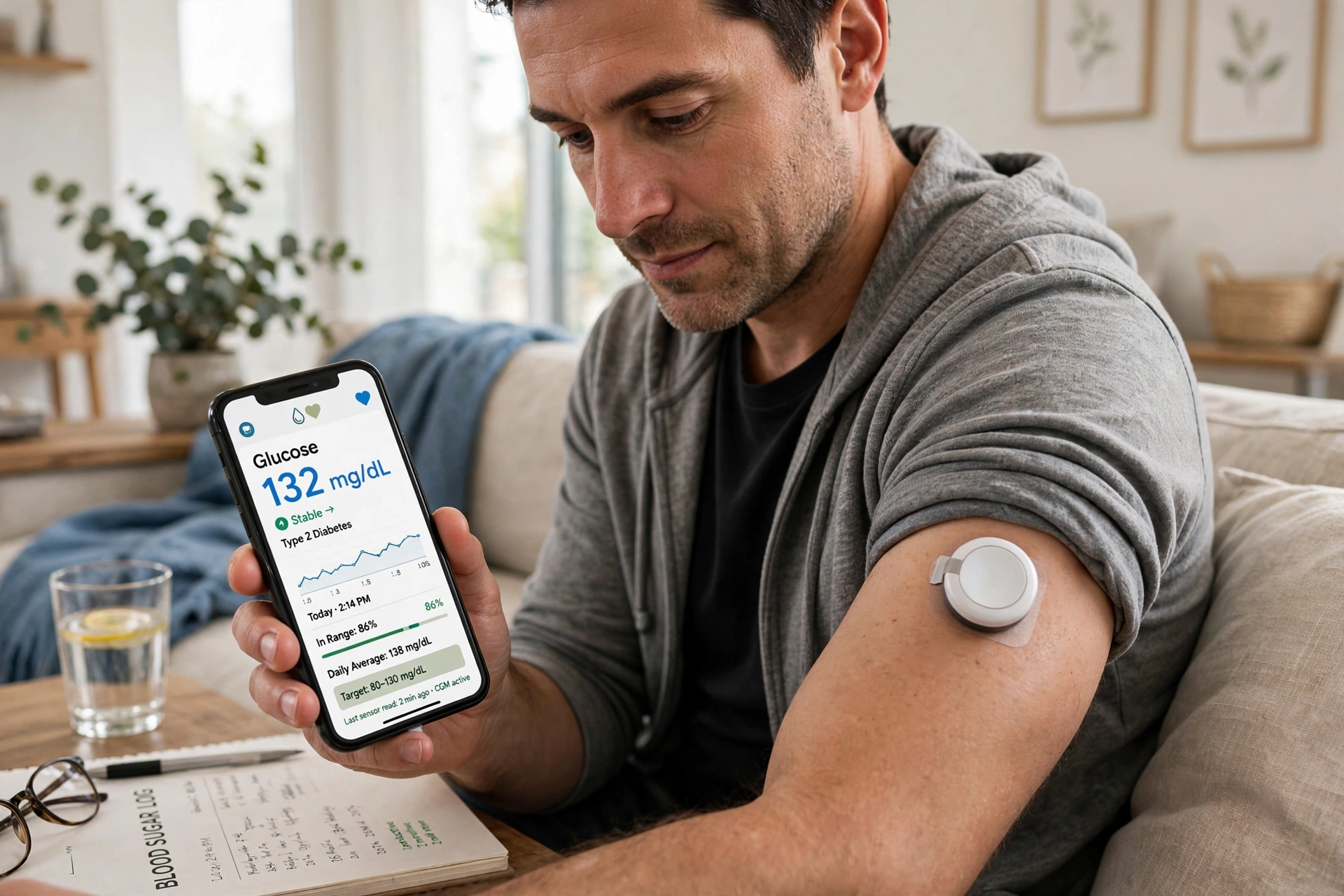
Continuous glucose monitors could help millions of adults with type 2 diabetes who do not use insulin, according to the largest clinical trial of its kind, published in the New England Journal of Medicine. Participants wearing the small, arm-worn sensors spent approximately five more hours each day in their target blood sugar range than those relying on conventional monitoring.
The result matters because time in range is closely linked to long-term outcomes in diabetes. Every extra hour spent with blood sugar at healthy levels is an hour in which the eyes, kidneys, nerves and cardiovascular system are under less strain. For a condition that affects hundreds of millions of people worldwide, an improvement measured in hours per day, every day, is substantial.
What the Trial Found
Researchers reported that adults assigned to continuous glucose monitoring, often shortened to CGM, saw their glucose stay within the recommended range for roughly five hours longer per day than the comparison group. The findings were summarised by the University of Colorado Anschutz Medical Campus, whose researchers were involved in the work, and the full study appears in the New England Journal of Medicine.
Until now, CGM has been prescribed most often to people with type 1 diabetes and to those with type 2 diabetes who use insulin. People managing type 2 diabetes with oral medication, diet and activity have usually relied on occasional finger-prick tests, which capture a single moment rather than a pattern. This trial asked a simple question: what happens when those patients can see their glucose continuously, including overnight and after meals?
Why Continuous Data Changes Behaviour
Clinicians say the benefit is not the sensor itself, but what people do with the information. A continuous trace shows immediately how a particular meal, a walk after dinner, stress or poor sleep affects blood sugar. Peaks that a finger-prick test would miss become visible, and so do the small changes that flatten them.
That feedback loop is powerful. Instead of reviewing a handful of readings at a clinic visit every few months, patients can experiment in real time and learn which habits work for them. Dietitians involved in diabetes care describe it as turning guesswork into evidence — a theme that also runs through our recent coverage of what new research says about ultra-processed food and gut health.
Who Stands to Benefit Most
The largest gains are expected among adults whose blood sugar is above target despite oral medication, and who have had few practical tools to understand why. Continuous monitoring can reveal nocturnal lows, dawn rises in glucose and post-meal spikes that would otherwise go unnoticed, giving doctors far better information when adjusting treatment.
There are caveats. Sensors cost money, supplies must be replaced regularly, and not every health system or insurer currently covers CGM for people who do not use insulin. The trial’s scale and its publication in a leading journal are likely to strengthen the case for wider coverage, but access decisions will vary by country and by plan.
What Patients Should Know
Doctors stress that a monitor is a tool, not a treatment on its own. Readings should be discussed with a clinician, especially before changing medication, and the devices work best alongside the foundations of diabetes care: balanced meals, regular activity, adequate sleep and prescribed therapy taken consistently.
People interested in CGM can ask their care team three practical questions: whether their current readings are in range, whether continuous data would change any treatment decisions, and what their coverage options are. For many, a short trial period with a sensor provides enough insight to reshape daily habits long after the device comes off.
The Bigger Picture
The study adds to a broader shift in chronic disease care, in which wearable sensors move management from occasional snapshots to continuous understanding. Similar approaches are being tested in blood pressure, sleep and heart rhythm monitoring, with the same underlying idea: earlier, clearer signals lead to better decisions.
For adults living with type 2 diabetes, five extra hours a day in a healthy range is not an abstract statistic. It is better mornings, steadier energy and, over years, a lower risk of the complications patients fear most. If access expands to match the evidence, this trial may be remembered as the moment continuous monitoring became a standard part of type 2 diabetes care, rather than a privilege reserved for a few.
