

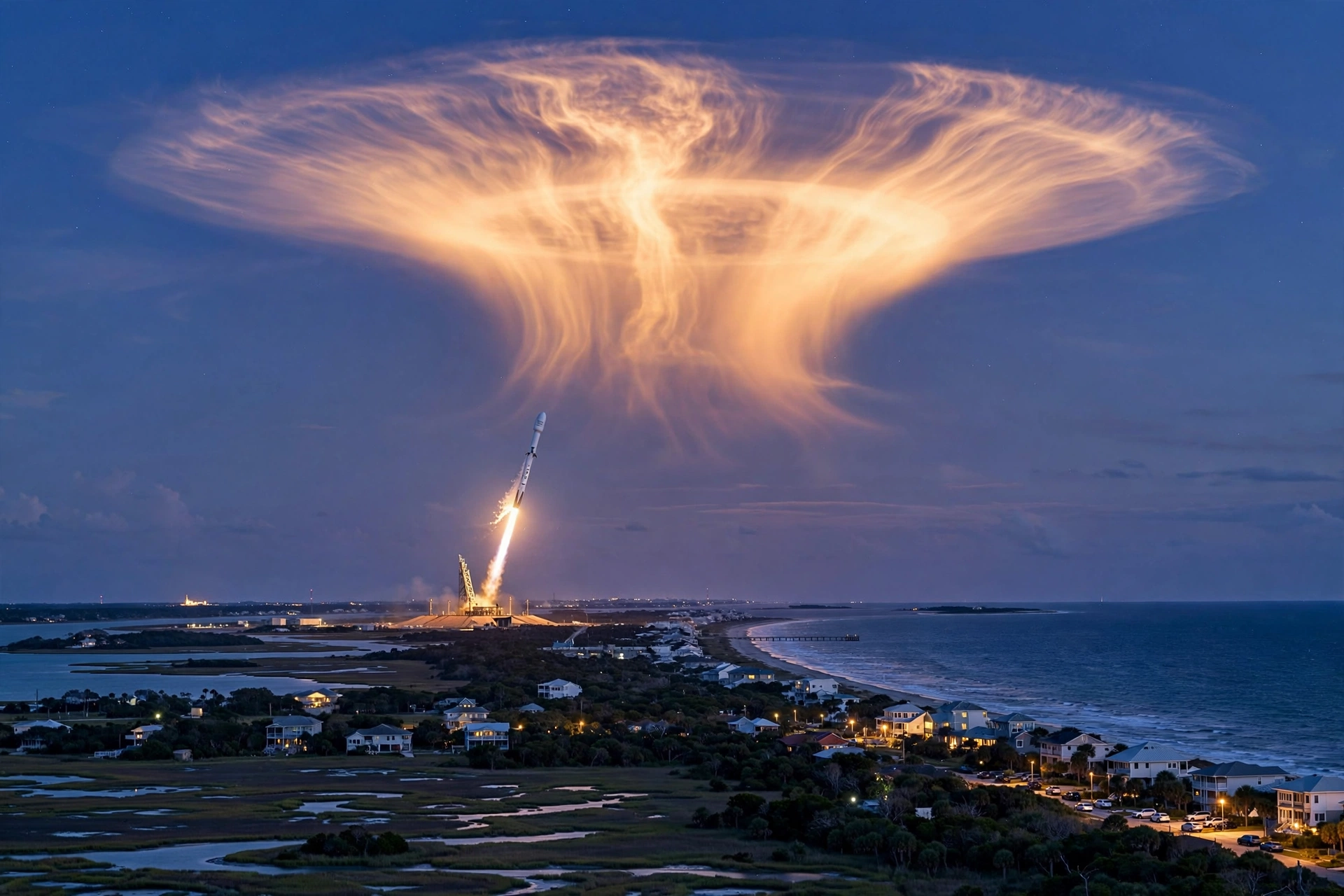
Residents along the US east coast looked up this week to find something extraordinary hanging in the twilight sky: a vast, glowing, jellyfish-shaped cloud, its luminous tendrils spreading slowly against the darkening blue. The spectacle was not a weather event or anything unexplained. It was the exhaust plume of a SpaceX rocket launch, caught by sunlight high above the Earth while the ground below was already in shadow.
Photos and videos shared within minutes showed the plume expanding into a translucent dome with trailing streamers, a formation astronomers and launch watchers know as a “space jellyfish”. According to reporting by The Guardian, the display was visible across a wide stretch of the eastern seaboard, prompting a flood of calls and social media posts from people who had never seen anything like it.
What Creates a Space Jellyfish?
The phenomenon depends on timing. When a rocket launches shortly before sunrise or shortly after sunset, its exhaust plume rises into a part of the upper atmosphere that is still, or already, illuminated by the sun. The plume of water vapour and gases expands rapidly in the thin air, and sunlight scattering through it makes it glow brightly against a dark sky at ground level.
As the rocket climbs and its engines throttle, the plume fans out. Upper-atmosphere winds then stretch and twist it into the curved bell and trailing tendrils that give the formation its jellyfish nickname. The effect can last for several minutes before the gases disperse, and it is most dramatic on clear evenings with little cloud cover — exactly the conditions reported along the coast this week.
Why This Launch Drew So Much Attention
Twilight launches are not new, and SpaceX flies frequently from Florida. What made this display stand out was the combination of a clear sky, a densely populated viewing corridor and the sheer scale of the plume. From beaches, rooftops and highways, onlookers watched the cloud bloom and drift, with many initially unsure whether they were seeing a rocket, a comet or something stranger.
Local interest in how large launches ripple through the wider economy is growing too. Our explainer on global and domestic market indicators looks at how investors track the signals that move sentiment day to day, including the fast-growing commercial space sector.
A Busier Sky Ahead
The sight is likely to become more familiar. Launch cadences have risen sharply in recent years, driven by satellite constellation deployments, cargo missions and preparations for crewed deep-space flights. Agencies such as NASA now work alongside commercial providers on a launch calendar that can see multiple liftoffs in a single week from US spaceports.
Each twilight window offers another chance for the jellyfish effect. Astronomers note that the best opportunities come in the roughly thirty minutes after sunset or before sunrise, when the contrast between a dark landscape and a sunlit plume is at its strongest. Photographers who want to capture it are advised to watch launch schedules, choose an unobstructed eastern or coastal viewpoint, and use long exposures as the plume expands.
Not to Be Confused With Other Sky Phenomena
Experts were quick to distinguish this week’s display from natural cloud formations and from atmospheric events such as noctilucent clouds, which form much higher and appear as delicate, rippling veils in deep twilight. A launch plume, by contrast, is tied to a known liftoff time, expands from a visible point and changes shape quickly as winds shear it apart.
There were no reports of any risk to the public. Exhaust plumes at that altitude disperse high above populated areas, and the glow is purely reflected sunlight. Officials simply encouraged people to enjoy the show — and to check the launch calendar before assuming the sky is doing something mysterious.
What Happens Next
For residents who missed it, the advice from seasoned launch watchers is simple: there will be another chance, and probably soon. As commercial launch activity continues to expand, twilight jellyfish clouds are becoming a regular, if still startling, feature of life along the space coast and far beyond it.
Understanding how everyday systems work behind the scenes is a theme across our coverage, from rocket plumes to the payment processing delays that can frustrate shoppers and businesses alike. This week, though, the lesson was written in the sky itself: sometimes the most otherworldly sight of the year has a thoroughly human explanation, launched on schedule and lit by the setting sun.
