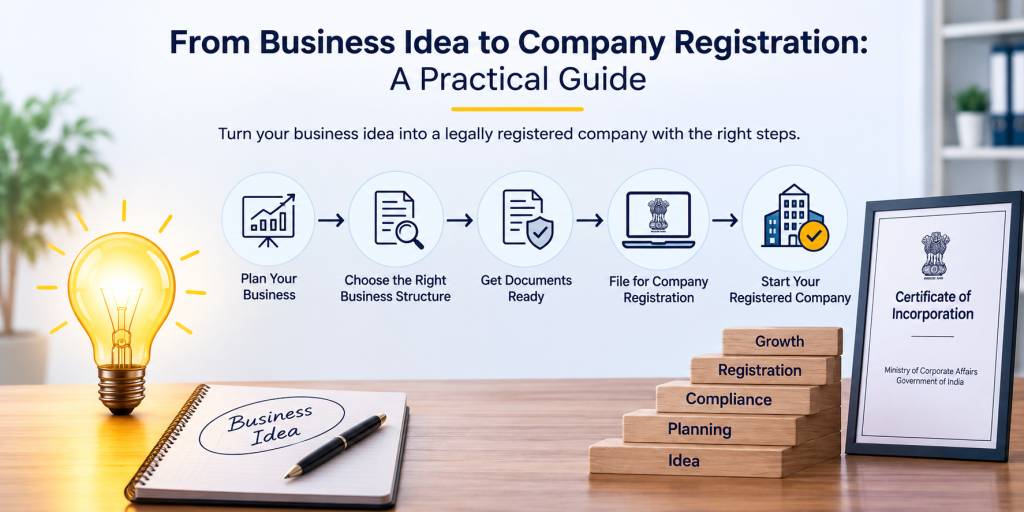
Every company you admire today, from a neighbourhood D2C brand to a unicorn startup, started the same way: as an idea scribbled on a notepad. What separates a hobby from a business, though, is a legal identity. Until you register your company, you cannot open a current bank account in the company’s name, sign contracts as a separate legal entity, raise funding from investors, or protect yourself from unlimited personal liability.
Yet for most first-time founders, company registration in India feels like a maze of unfamiliar terms, SPICe+, DIN, MOA, AOA, DSC, and an even more confusing set of portals. The good news is that the Ministry of Corporate Affairs (MCA) has consolidated almost the entire process into a single web-based form, and a well-prepared application can now get you incorporated in a matter of days, not months.
Why Registering Your Company Matters
Company registration (or incorporation) is the legal process of creating a company as a distinct entity under the Companies Act, 2013, separate from its founders. Once registered, the company can own assets, enter contracts, sue and be sued, and continue to exist even if its founders leave.
Did You Know? Once incorporated, a private limited company is treated as a separate person in the eyes of the law, a concept known as perpetual succession. The company doesn’t dissolve even if every original director resigns or passes away.
Operating an unregistered business isn’t illegal by itself, millions of Indians run sole proprietorships this way, but it comes at a cost:
| Risk of staying unregistered | Consequence |
| Unlimited personal liability | Your personal assets (home, savings) can be used to settle business debts |
| No separate legal identity | You cannot sign contracts, leases, or NDAs as a company |
| Limited fundraising | Angel investors and VCs almost never invest in unregistered entities |
| No brand protection | Your business name has no statutory protection until registered |
| Credibility gap | Larger clients and government tenders often require a registered entity |
| No DPIIT/Startup India benefits | Tax holidays and IPR rebates require prior incorporation |
Step 1: Validate Your Idea and Choose the Right Business Structure
Your business structure determines your liability, taxation, compliance burden, and ability to raise funds. Choosing incorrectly at the start often means an expensive conversion later, so this decision deserves as much thought as the business idea itself.
Before you file anything with the MCA, ask:
- Will you take on co-founders or external investors?
- Do you need limited liability protection?
- What is your expected annual turnover in year one?
- Are you eligible for DPIIT/Startup India recognition (sole proprietorships are not)?
Comparison of Business Structures in India
| Feature | Private Limited Company | LLP | One Person Company (OPC) | Sole Proprietorship |
| Governing law | Companies Act, 2013 | LLP Act, 2008 | Companies Act, 2013 | No specific statute |
| Minimum members | 2 shareholders, 2 directors | 2 partners | 1 shareholder, 1 director | 1 owner |
| Liability | Limited | Limited | Limited | Unlimited |
| Fundraising (VC/Angel) | Best suited | Difficult | Limited | Not possible |
| Compliance burden | High | Moderate | Moderate | Low |
| DPIIT eligibility | Yes | Yes | No (only Pvt Ltd, LLP, partnership, cooperative) | No |
| Ideal for | Startups, scalable businesses | Professional/service firms | Solo founders wanting limited liability | Small local businesses |
Common Mistake: Many first-time founders register a sole proprietorship because it’s quick and cheap, then struggle to raise funding or bring on a co-founder later. If fundraising or scaling is even a possibility, a Private Limited Company Registration is usually the safer long-term choice.
Step 2: Reserve Your Company Name (SPICe+ Part A)
SPICe+ (Simplified Proforma for Incorporating Company Electronically Plus) is the single, integrated web form on the MCA V3 portal through which every new company in India is incorporated. It bundles name reservation, incorporation, DIN allotment, PAN, TAN, GSTIN, EPFO, ESIC, professional tax enrolment, and bank account opening into one structured application, replacing what used to require filings across five separate portals.
SPICe+ has two parts, filed in sequence:
- Part A – Name reservation
- Part B – Incorporation, DIN allotment, and linked registrations
How to reserve a company name
- Create a Business User Account on the MCA V3 portal (mca.gov.in).
- Propose up to two names in order of preference, ensuring they are not identical or too similar to an existing company, LLP, or registered trademark.
- The name must reflect the company’s main objects (business activity) and comply with the Companies (Incorporation) Rules, 2014.
- Pay the applicable fee and submit for approval by the Central Registration Centre (CRC).
Important: Once approved, a reserved name under SPICe+ Part A is valid for a limited window, if Part B is not filed within that period, the name reservation and the associated fee lapse, and you must restart the process. Plan your document collection in parallel to avoid losing your window.
Step 3: Gather Documents and Digital Signatures
Before filing SPICe+ Part B, keep the following ready. Incomplete or mismatched documents are the single biggest cause of resubmission notices from the Registrar of Companies (ROC).
Documents Required Checklist
For Directors/Subscribers:
- PAN card (mandatory for Indian nationals)
- Aadhaar card
- Passport-size photograph
- Identity proof (Voter ID/Passport/Driving Licence)
- Address proof, bank statement or utility bill not older than 2 months
- Digital Signature Certificate (DSC), Class 3, for all directors and subscribers
For Registered Office:
- Proof of registered office (rent agreement/sale deed)
- No Objection Certificate (NOC) from the property owner
- Latest utility bill (electricity/water/gas), not older than 2 months
For the Company:
- Draft Memorandum of Association (e-MOA / INC-33)
- Draft Articles of Association (e-AOA / INC-34)
- Declaration by first directors and subscribers
AGILE-PRO-S, a linked form, must be filed alongside SPICe+ even if you choose to opt out of some of its registrations (like GST) at this stage.
Step 4: File SPICe+ Part B and Get Incorporated
SPICe+ Part B is where the actual incorporation happens. It captures details of directors, subscribers, share capital, registered office address, and the linked registrations you want to apply for simultaneously.
The filing process, step by step
- Fill in company details, authorised and paid-up share capital, registered office address, main business activity (with the correct NIC code).
- Add director and subscriber details, including DIN application for directors who don’t already have one (up to three DINs can be allotted in a single SPICe+ application).
- Attach linked forms, e-MOA, e-AOA, and AGILE-PRO-S.
- Upload supporting documents listed in the checklist above.
- Affix Digital Signatures of all directors and subscribers, and of the professional certifying the form (CA/CS/CMA, where applicable).
- Pay fees, government incorporation fee, stamp duty (state-specific), and professional certification charges.
- Submit to the ROC for processing via the Central Registration Centre.
Timeline and Fees
| Stage | Typical Timeline |
| Name reservation (Part A) approval | 1–2 working days |
| Document preparation & DSC issuance | 2–5 working days (founder-dependent) |
| SPICe+ Part B processing by ROC | 3–5 working days |
| Total (well-prepared application) | 7–10 working days |
Fee note: For companies with an authorised capital of up to ₹15 lakh, the government incorporation fee is nil. The real out-of-pocket costs typically come from state-wise stamp duty (calculated automatically on the portal), DSC issuance, and professional certification fees, not the incorporation fee itself.
Latest News: SPICe+ is now the only route for new company incorporation on the MCA V3 portal, there is no legacy form or alternate filing path for standard company registrations, making it essential to get the Part A and Part B filings right the first time.
On approval
Once the ROC is satisfied, it issues:
- Certificate of Incorporation (COI), bearing your Corporate Identity Number (CIN)
- PAN
- TAN
- GSTIN, EPFO, and ESIC registrations, where applied for
Case Study: A Bengaluru-based SaaS startup consolidated what would earlier have been five separate applications, MCA, NSDL (PAN/TAN), GST, EPFO, and ESIC, into a single SPICe+ filing. With documents ready in advance and DSCs issued upfront, the founders received their Certificate of Incorporation, PAN, and TAN within eight working days of filing Part A.
Step 5: What to Do Immediately After Incorporation
Registration is the beginning of your compliance journey, not the end. Founders often assume the job is done once the COI arrives, but several time-sensitive steps follow.
Post-incorporation compliance checklist
- Open a current bank account in the company’s name
- Deposit subscribed share capital within 180 days of incorporation and file Form INC-20A (Declaration of Commencement of Business)
- Appoint a statutory auditor within 30 days of incorporation
- Issue share certificates to subscribers within 60 days
- Maintain statutory registers (register of members, directors, charges)
- File annual returns (MGT-7) and financial statements (AOC-4) each year
- Apply for DPIIT/Startup India recognition, if eligible
Should you apply for DPIIT recognition right after incorporation?
Yes. DPIIT recognition is a separate, one-time application on the Startup India portal, distinct from MCA incorporation, that unlocks a three-year income tax holiday under Section 80-IAC, angel tax exemption, an 80% rebate on patent filing fees, and access to the Startup India Seed Fund Scheme. It’s free, typically processed within 7–14 days, and available to companies within 10 years of incorporation (20 years for recognised Deep Tech startups). Because the tax-holiday window is counted from your date of incorporation, not your date of recognition, applying early maximises the benefit.
Common Mistakes Founders Make During Registration
- Choosing the wrong structure to save on short-term compliance costs, then converting later at higher expense
- Letting the Part A name approval lapse by not filing Part B in time
- Mismatched addresses between Aadhaar, utility bills, and the application
- Incomplete NIC code selection, causing ROC queries
- Delaying DSC issuance, which stalls the entire filing timeline
- Skipping DPIIT registration, losing out on the 80-IAC tax holiday window
- Forgetting Form INC-20A, which can lead to penalties and even striking off the company
Conclusion
Turning a business idea into a registered company is no longer the months-long ordeal it once was. With SPICe+ consolidating name reservation, incorporation, PAN, TAN, and multiple statutory registrations into a single MCA V3 filing, a well-documented application can be approved in as little as 7–10 working days. But speed depends entirely on preparation, the right business structure, accurate documents, timely DSCs, and awareness of deadlines like the Part A validity window and the 180-day capital infusion rule.
Getting incorporation right the first time saves founders from resubmission delays, compliance penalties, and missed opportunities like DPIIT recognition. If in doubt, professional guidance at the registration stage pays for itself many times over in the years of compliance that follow.
Why Choose Zolvit
- Expert lawyers, CAs, and Company Secretaries who handle your filing end-to-end
- Fast processing, from name reservation to Certificate of Incorporation
- Affordable, transparent pricing with no hidden charges
- End-to-end compliance support, incorporation, DPIIT recognition, GST, and annual filings
- Dedicated support to track your application status and resolve ROC queries quickly
CTA: Don’t let paperwork slow down your business idea.
Talk to a Zolvit company registration expert today and get your SPICe+ filing done right, the first time.
FAQs
1. Can I register a company without a physical office?
YES. You can use a residential address or a virtual office as your registered office, provided you submit valid proof of address and a No Objection Certificate from the owner. The address must be capable of receiving official communication from the ROC.
2. How long does company registration take in India?
A well-documented SPICe+ application is typically processed in 7–10 working days, covering name approval, Part B filing, and issuance of the Certificate of Incorporation, PAN, and TAN. Delays usually stem from document mismatches or DSC issues.
3. Is GST registration compulsory at the time of incorporation?
NO. GST registration can be applied for through the linked AGILE-PRO-S form at incorporation, or separately later once your turnover crosses the applicable threshold or you begin interstate supply. Many founders apply early for credibility with vendors and clients.
4. Can a foreign national be a director in an Indian company?
YES. Foreign nationals and NRIs can be directors, subject to at least one director being a resident of India for a minimum period during the financial year, as required under the Companies Act, 2013.
5. Should I choose an LLP or a Private Limited Company for a tech startup?
For most tech startups planning to raise external funding, a Private Limited Company is preferable, since LLPs cannot issue equity shares and are generally unattractive to venture capital investors. LLPs suit professional or service-based businesses with steady, self-funded growth.